Stock music rejected: the common reasons and what to do next
A rejection is an answer about one track on one site. Here are the usual reasons, what each site's notice means, and what to do next.
In short. Stock sites reject music for a few kinds of reasons: technical problems, production, commercial use, metadata and rights. Some notices let you fix the track and send it again. Others are final on that site. On AudioJungle a soft rejection can be fixed, and a hard rejection cannot be resubmitted. Write down every rejection with its reason, and send the track to another site where your agreements allow it.
The common reasons
Reviewers rarely explain much. But the sites' own help pages say what they check. Most rejections fall into one of the groups below.
Technical
- Wrong format. Every site has its own specs. AudioJungle wants 44.1 kHz, 16-bit stereo, as WAV and/or MP3 at 320 kbps. Pond5 takes WAV or AIFF and rejects MP3 and FLAC. Shutterstock's music team asks for MP3 files up to 15 MB.
- Noise and distortion. Envato asks for live recordings without room sounds: a creaking bench, breathing, coughs. Pond5 asks for cleanly recorded files. Some distortion as a creative choice is fine.
- Levels. Envato asks for steady volume, without sudden jumps or drops. It also warns against compressing a track until it loses its dynamics. Compare your levels with other tracks on the site.
- The ending. A track should end properly or fade out naturally. Envato asks you to fix a track that stops abruptly. For sound effects, it also asks for no silence before or after the sound.
- The watermark. On AudioJungle, a preview of two seconds or longer needs the AudioJungle watermark, about every 10 seconds. It must be audible but not distracting. Do not change its pitch or add effects to it.
Production
- The mix. Shutterstock says poor production quality is often why it declines music. Envato asks that each instrument has its own frequency range, and that reverb and delay stay moderate.
- Dated sound. Shutterstock's advice is to drop the 80s synth pads and sound current. Envato warns against default sounds from your software, used as they are. They often sound dated and cheap.
- The arrangement. Envato warns against too much repetition without development. Shutterstock asks you to avoid slow progress and monotony.
Commercial use
- No clear use. Envato rejects items without "sufficient commercial utility". Motion Array rejects assets without commercial use or member demand.
- A long intro. Envato advises against long introductions, because most projects do not need them.
- Breaks and big changes. Pauses, strong tempo or style changes, and long solos make a track harder to put under a voiceover.
- Too similar. Envato says it may have plenty of this kind already, or not enough demand. Motion Array may reject work that is too close to what it has.
- Too niche. Shutterstock says not to go too niche in genre or era. Envato may turn down music that is too abstract or experimental. Motion Array may reject seasonal work that only fits one year.
Metadata
- The title. AudioJungle titles must be unique and make sense in English. No famous film or band names. No filler word "music", and no repeated words.
- Tag spam. AudioJungle allows a word, or words from the same root, in at most two tags. Only two words may repeat at all. It asks for at least five tags. Pond5 also asks you to avoid spam keywords. See How to tag stock music.
- The description and category. Envato rejects a description that is just a list of keywords. It also sends back items uploaded to the wrong category.
Rights
- Samples and loops. Shutterstock does not accept uncleared samples. Samples from libraries that allow production music use are fine. AudioJungle does not accept tracks built entirely on stock loops. A drum loop inside your own composition is fine. Pond5 says the loops must be cleared for resale, and the track must be your own work.
- Sound-alikes and covers. Shutterstock does not accept sound-alikes, covers or music that is not 100% original. Motion Array does not allow derivatives or pastiche.
- AI. Envato does not allow AI-generated content as the main part of an item. Storyblocks may remove accounts that keep uploading AI content. Pond5 says it cannot accept AI-generated content.
Duplicates and Content ID
Pond5 checks for duplicate files while it processes an upload. If your track is registered in YouTube Content ID, each site has rules. Motion Array accepts registrations only with AdRev, Artlist, CDbaby, EpicElite, HAAWK and Identifyy. Envato asks you to mark the registration on the item, and to make sure buyers' claims get cleared. Pond5 forbids anything that stops buyers from monetizing their videos. See YouTube Content ID.
What each site's notice means
As of October 2026, from each site's own help pages:
| Site | Notice | Can you send it again? |
|---|---|---|
| AudioJungle | Soft rejected | Yes. Make the changes in the reviewer's notes, then open the item in Hidden Items, click Edit, then Submit. |
| AudioJungle | Hard rejected | No. There is no feedback. Only a new item, changed enough to be a brand-new track. Sending the same one again puts your upload rights at risk. |
| Pond5 | Needs Edits | This is not a rejection. The file is waiting for its title, description and keywords, and for you to submit it. |
| Pond5 | Returned | Yes. The curator's note says what is missing: a title, keywords, English text, a release. Fix it and submit. |
| Pond5 | Rejected | Read the email. If it asks you to upload the file again, for example after a glitch or a wrong format, do that. Otherwise the same file sent again is rejected again. |
| Motion Array | Changes Needed | Yes. Read the notes in My Submissions or in the email, edit the item, click Next, then Submit. |
| Motion Array | Rejected | The team does not discuss rejections. Send new work with the reasons in mind. |
| Shutterstock (music) | Declined | No. Shutterstock reviews one batch of up to five tracks per artist. It does not review a second submission. |
Who can join also changes. As of October 2026, Envato is not creating new author accounts, and it is not inviting audio authors. Shutterstock music buys tracks outright, exclusively.
What to do next
- Read the reason. Open the email and the notice in your dashboard. Envato sends one summary email a day by default. You can change that in Email Settings.
- If you can fix it, fix it and send it the way the site says. Do not delete the track and upload it again as a new one. Pond5 rejects that. Envato may suspend authors who send rejected items again without changes.
- If it is final, leave it on that site. Then choose: rework it into a clearly new track, or send it as it is to another site. Each site has its own catalog and its own buyers. A track one site has enough of may be what another one needs.
- Check your agreements first. A track sold exclusively somewhere cannot go to another site. See Exclusive or non-exclusive.
- If the reason is rights or AI, fix the cause before you send it anywhere. Other sites have similar rules.
Keep a record of rejections
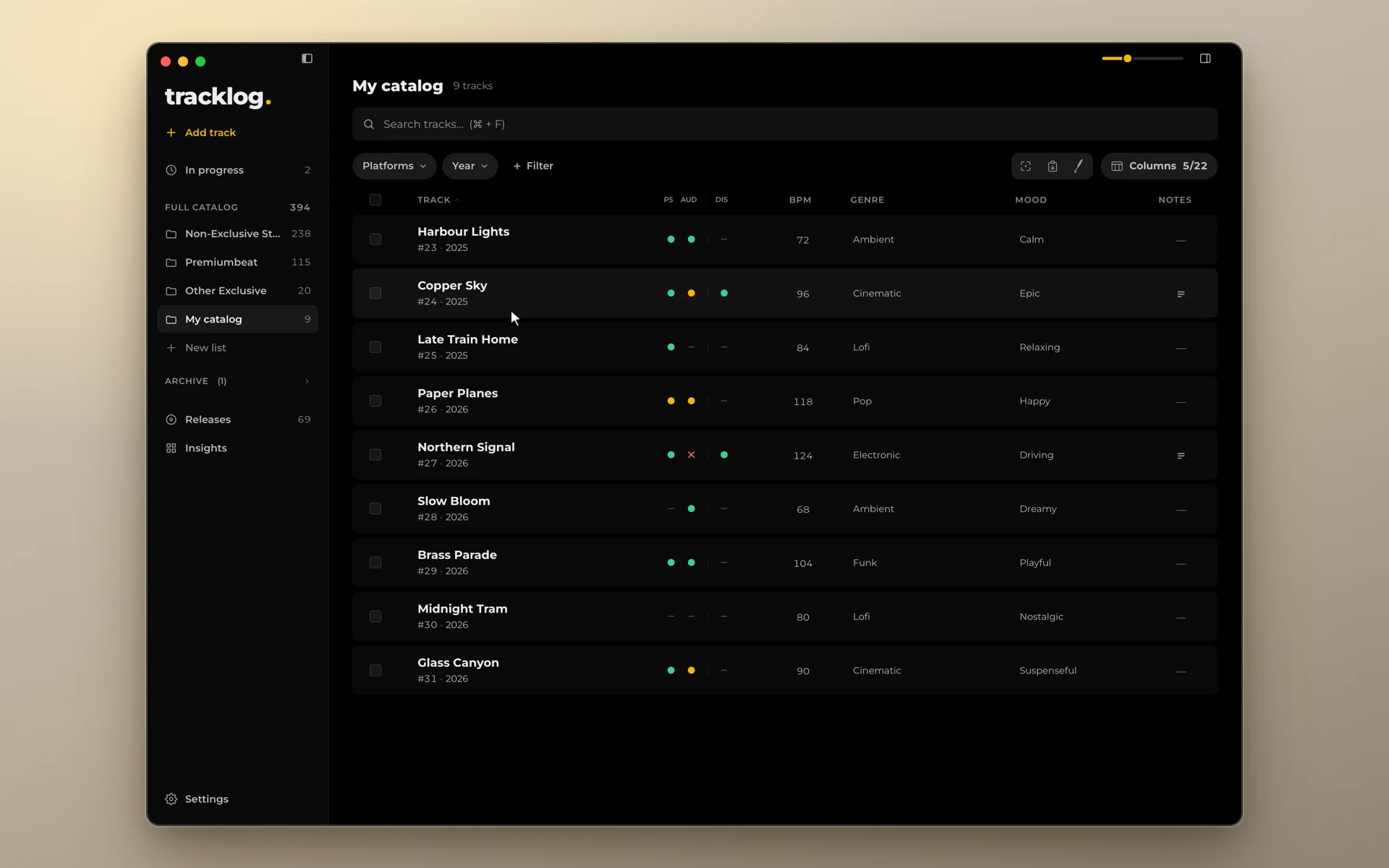
For every rejection, write down five things: the track, the site, the date, the type of notice, and the reason in the site's own words.
After a few months, the record shows patterns. One site keeps rejecting your lo-fi but takes your corporate tracks. Another keeps returning files for the tags. "Too similar" in one genre means that site has enough of it. Then you stop sending that style there and send it where it is accepted.
The record also stops a costly mistake. Without it, you may send a hard-rejected track to the same site again, months later. See How to keep track of where your music is uploaded.
Sources
- Review Process FAQs, Envato Author Help Center
- How to Get Your Items Through Review at Envato, Envato Author Help Center
- Most Common Item Rejection Reasons, Envato Author Help Center
- AudioJungle Authors FAQ, Envato Author Help Center
- Audio Item Preparation and Technical Requirements, Envato Author Help Center
- Trending Items and Quality Tips, Envato Author Help Center
- Can I use pre-existing audio loops samples?, Envato Author Help Center
- AI-generated content policy for Market and Elements, Envato Author Help Center
- Registering Your Music With YouTube Content ID, Envato Author Help Center
- Author applications are paused, Envato Author Help Center
- Does Storyblocks accept AI generated content?, Storyblocks Contributor FAQ
- Uploading your files, Pond5 Contributor Portal
- Upload Status: Needs Edits or Returned, Pond5 Contributor Portal
- Music, Pond5 Contributor Portal
- Tagging and pricing your files, Pond5 Contributor Portal
- Contributor FAQ, Pond5
- How do I become a Music Contributor?, Shutterstock Contributor Support
- Why was my submission rejected?, Motion Array Artists Hub
- How to Edit Your Submission After Getting Feedback, Motion Array Artists Hub
- Motion Array upload rules, Motion Array Artists Hub