Music libraries to submit to, and how to apply
Some places let anyone upload. Others want an application and pick a few. Here is who takes music as of October 2026, on what terms, and how to apply without losing track.
In short. Stock marketplaces such as Melody Loops and Jamendo Licensing let anyone open an account and upload. Libraries such as Audio Network, Audiosocket and PremiumBeat ask for an application with a few of your best tracks. Many big subscription libraries are closed to new artists right now. Check whether each place wants the track exclusively before you send it. Then write down who you applied to, when, with which tracks, and what they answered.
Library or marketplace
A stock marketplace is a shop. You upload, the site checks each track, and buyers pay per license. Anyone can join.
A production music library is closer to a publisher. It picks composers, often asks for music to a brief, and pitches it to TV, film and advertising. It often registers the works with performing rights societies and keeps the publisher's share. See Registering library music with your PRO.
A subscription library sits between the two. Buyers pay a monthly fee, and authors are paid from a shared pool or upfront. Most of them choose artists strictly.
Exclusive or not
A non-exclusive place lets the same track be anywhere else too. An exclusive one wants the track for itself alone, often for years. Marketplaces are usually non-exclusive. Libraries are often exclusive. Read the terms before you send a single file. The full comparison and the questions to ask: Exclusive or non-exclusive.
How submissions work
There are two ways in.
- Open upload. You create an account and upload. Each track is still reviewed, and some are rejected. You learn fast which tracks the site wants.
- Application. You send a short form with a link to your music. A team listens and answers, or does not. Shutterstock says its review "can take up to a few months". Audiosocket says it answers within 90 days.
What applications ask for, from the forms themselves:
- A link to your best work. Audio Network asks for one "Sure to Impress" playlist: the best example of what you can do.
- A few tracks, not your whole catalog. PremiumBeat takes up to 5 tracks in the first batch. Audiosocket asks for four original songs.
- A short bio. Audio Network allows up to 250 words.
- Your genre and your society. Audio Network asks which genre you work in and which performing rights society you belong to.
- Your other deals. Audio Network asks if you are signed exclusively elsewhere. It says it typically can't work with artists who are.
Send your strongest work first. Shutterstock says it will not review several submissions from the same artist. You may get only one try.
Places that take music now
Checked on each one's own contributor or submission page in October 2026. Terms change, so open the page again before you apply.
| Place | Type | How to get in | Exclusive? |
|---|---|---|---|
| Melody Loops | Marketplace | Open: create an account, tracks are reviewed | No |
| Pond5 | Marketplace | Open: free account, ID check, review of each file | No. Its exclusive program is for video only |
| Jamendo Licensing | Marketplace | Open: accept the agreement, each track is reviewed | Your choice. Your revenue share depends on it |
| AudioSparx | Marketplace | Create an account, then send an artist application | No. But the license is forever: you can't take tracks down |
| Storyblocks | Subscription | Apply. Storyblocks reviews your portfolio | Yes, for music. You may still release it on streaming services |
| Shutterstock (PremiumBeat) | Library | Apply with up to 5 tracks | Yes |
| Audio Network | Library | Apply by form with a link to your best work | Yes. Its catalog is "wholly owned" |
| Audiosocket | Library | Apply with four original songs | Your choice: a non-exclusive or an exclusive deal |
Closed to new artists when checked on 26 October 2026: AudioJungle (Envato Market), Epidemic Sound, Artlist, Motion Array, Soundstripe, Uppbeat, Music Vine and Marmoset. Envato takes new authors only by invitation, and it is not inviting audio authors. Marmoset has paused its form to work through a backlog. The others say to check back. Songtradr closed its marketplace: its licensing is now by invitation only. Read their terms closely when they open. Soundstripe takes only music made for it, as "works made for hire". Epidemic Sound says its deal does not work for artists in a collecting society.
How to pick the first ones
- Start with one open marketplace, such as Melody Loops. You learn file specs, titles and tags, and you get your first reviews. See How to sell music on stock sites.
- Add one library that fits your music. Listen to its catalog first. If you can't hear where your track would sit, wait.
- Keep exclusive and non-exclusive tracks apart from day one. A track on a marketplace can't go to an exclusive library. Decide per track, not per mood.
- Have the versions ready. Libraries often want cutdowns, an underscore and stems once you are in. See Versions, cutdowns and stems.
A short submission email
Most libraries use a form. Some ask you to write. Musicbed's help page, for example, says to email its support to learn about the process. Keep the email short. The person reading it gets many.
Subject: Submission: cinematic and ambient production music
Hi,
I write cinematic and ambient music for picture. Here are my three strongest tracks: [link]
All tracks are 100% mine. No samples, no other deals on them. I am a member of [society], IPI [number].
Each track has a full mix, 60, 30 and 15 second cutdowns, and stems.
Thank you for listening. [Name]
Rules that help:
- One link, to a private playlist, not a folder of files.
- Three to five tracks, your best, in the style the library sells.
- Say what is free. Tell them if any track is already on a stock site.
- No follow-up for a few weeks. Then one short message is fine.
What to track after you apply
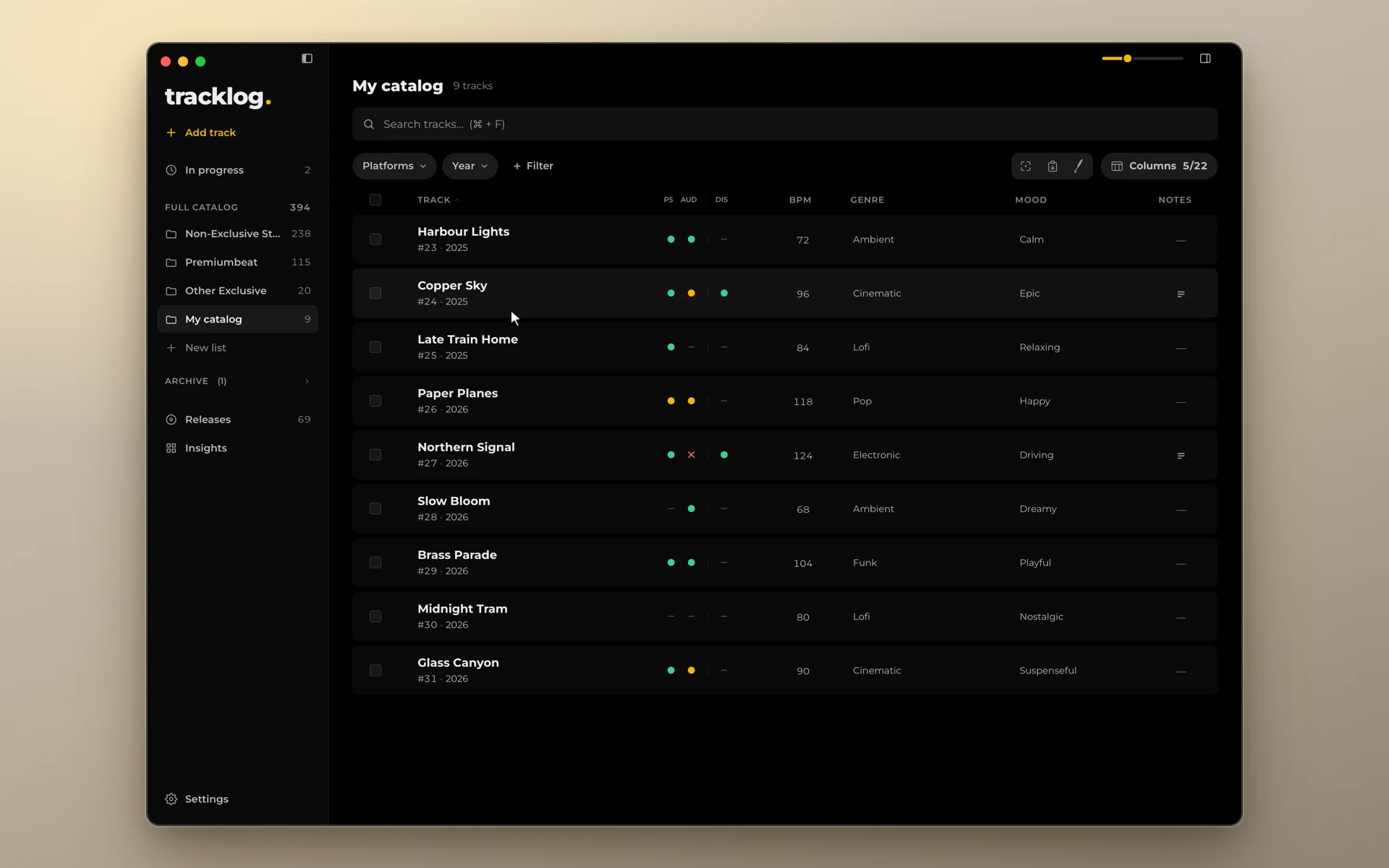
An application is easy to forget. Three months later, an answer arrives, and you can't remember which tracks you sent. Write down, for each place:
- Where you applied, and how: form or email.
- When you applied.
- Which tracks you sent, by their titles in your catalog.
- The answer and its date: accepted, rejected, or none yet.
- The terms, if accepted: exclusive or not, and for how long.
Composers have asked the same questions for years:
"How do you keep track of your submissions to the various music libraries and projects? Who accepted and who rejected? What songs are placed with what companies and the alternate titles for each song?"
Mark the tracks you sent as under review for that place. Then they don't go anywhere else by accident while you wait. For tracks that are already live in many places, see How to keep track of where your music is uploaded.
Sources
- Changes to Envato Market revenue share and exclusivity, Envato Author Hub
- Author applications are paused: new authors join by invitation only, Envato Author Help Center
- Melody Loops Composers, Melody Loops
- Contributor FAQ, Pond5
- Jamendo Licensing, Jamendo Artist Support
- Submit Music to AudioSparx, AudioSparx
- How do I apply and how long does it take?, Storyblocks Contributor Support
- How to sell your music on Storyblocks, Storyblocks Contributor Support
- How do I become a music contributor?, Shutterstock Contributor Help
- Music submission form, Audio Network
- Our mission, Audio Network
- Join the Family, Audiosocket
- How do artists get started?, Audiosocket Knowledge Base
- For artists, Epidemic Sound
- Artist FAQ, Epidemic Sound
- Artist application, Artlist
- Become a producer, Motion Array
- Become a Soundstripe Artist, Soundstripe
- How do I apply to become a contributor?, Uppbeat Help Center
- Artist application, Music Vine
- Submissions, Marmoset
- What's happened to the licensing deals I was opted into previously?, Songtradr Help
- How can I submit my music to be on Musicbed?, Musicbed Help & Support