Music distributor, library or stock site: where your music goes
A distributor, a stock site, a music library and a PRO do four different jobs. Here is what each one does, who pays you, and when one track in several places starts a conflict.
In short. A distributor puts your release on Spotify, Apple Music and other stores, and passes on what they pay. A stock site sells a license each time someone puts your track in a video. A music library pitches your tracks to TV, film and ads, and often wants them alone. A PRO or a Content ID service sells nothing: it collects money for uses that happen anyway. One track can be in several of these places. The trouble starts with Content ID, exclusive deals and new titles.
Four kinds of places
Distributors
DistroKid, TuneCore, CD Baby and others. You upload a release. The distributor delivers it to streaming services and download stores. Listeners pay the stores, the stores pay the distributor, and the distributor pays you.
Fees differ. DistroKid, for example, says it passes on 100% of what the stores send. It takes 20% only from its optional Social Media Pack. That pack collects money from videos on YouTube, TikTok, Instagram and Facebook. Check each distributor's current terms. DistroKid also says you keep full ownership of the music you upload.
A distributor needs a finished release: the audio, cover art, the title, your artist name, and codes for the recording and the release. See ISRC, ISWC and UPC and the release checklist.
Each distributor has its own rules for music made with AI. See Can you sell AI music?
Stock music sites
AudioJungle (Envato), Pond5, Shutterstock, Motion Array and others. A buyer pays for a license to use your track in a video, an ad or a game. The site keeps part of the price and pays you the rest.
Most stock sites are non-exclusive: the same track can be on other sites. Envato Market, for example, removed its exclusivity rules on 1 July 2026. Since then every author pays the same 50% fee and may sell the same items elsewhere.
A stock site needs a finished file, often short edits, and a title, description and tags. Each site reviews what you send. See How to sell music on stock sites.
Production music libraries
A library is a publisher. It takes your tracks and pitches them to TV, film, ads and trailers. You earn from license fees and from performance royalties. The library often keeps the publisher's share of those royalties.
Many libraries want tracks exclusively. Some offer both kinds of deal. Audiosocket, for example, has a non-exclusive deal and an exclusive one, with different splits. Some libraries buy tracks outright. Epidemic Sound pays a fixed fee per track and becomes the sole owner of the financial rights. Its artists may not belong to a PRO.
A library usually wants strong tracks, versions and stems, and full details for each one. See Exclusive or non-exclusive and Versions, cutdowns and stems.
Collecting and registration services
These are not stores. Nobody buys anything there. They collect money for uses of your music that happen anyway.
- A PRO (performing rights organization) such as ASCAP, BMI or PRS. It pays songwriters, composers and publishers when their music is played in public: on TV, radio and streaming services. You register each work you write. See Registering library music with your PRO.
- A Content ID service such as HAAWK (Identifyy) or FUGA, which took over AdRev. It registers your recording in YouTube's Content ID. When a video uses the track, the video gets a claim, and you get part of the ad money. Many distributors offer this too, for example DistroKid's Social Media Pack. See YouTube Content ID.
Content ID needs exclusive rights. YouTube's own rule: you must have exclusive rights to the material you register.
Side by side
| Distributor | Stock site | Music library | PRO, Content ID service | |
|---|---|---|---|---|
| Who pays | Streaming services and stores | The buyer of a license | The productions that license the track | Broadcasters and platforms, through the society or YouTube |
| What you get | Streaming and download income | A share of each license | A share of fees, and the writer's share of royalties | Performance royalties, or ad money from videos |
| Exclusive | No | Usually no | Often yes | One registration per recording |
| What it needs | A finished release with cover and codes | Files, edits, title, tags | Strong tracks, versions, stems, details | Each work or recording registered once |
One track in several places
Can the same song be on DistroKid and on stock sites? As far as the stores go, usually yes. Distribution and stock sales don't exclude each other. The conflicts come from four places.
Content ID at the distributor
You release a track through a distributor and turn on Content ID. The same track sells on a stock site. A buyer licenses it and puts it in a YouTube video. Content ID finds the track and claims the video. The ad money now goes to you, not to the buyer who paid for the license.
Stock sites have rules about this:
- Motion Array accepts Content ID registrations only through AdRev, Artlist, CD Baby, EpicElite, HAAWK and Identifyy.
- Envato asks you to mark each registered item and name the company that registered it. You must clear buyers' claims quickly. If a Content ID company can't fully clear claims on Envato licenses, you must not register with it. As of October 2026, Envato's automatic clearing (Claim Clear) works only with HAAWK through Identifyy.
- Pond5 lets you submit your music to Content ID services. But you may not do anything on YouTube that stops buyers from earning money from their videos.
YouTube itself sends matches against "royalty free" production music to manual review before a claim. DistroKid lets you allow specific videos so they get no claim. But you don't know every future buyer in advance.
So decide track by track. Keep stock tracks out of Content ID at the distributor. Or register them through one company that your stock sites accept and that can clear buyers' claims.
Two companies, one recording
Only one company may register a recording in Content ID. DistroKid asks that no other company, such as TuneCore or CD Baby, has sent the same track there. CD Baby says the same recording can't be delivered by another distributor or administrator.
If a library or a Content ID service has already registered a track, leave Content ID off for it at the distributor.
Exclusive library deals
An exclusive deal means the track can't be on stock sites. Depending on the contract, it may not go to a distributor either. And the library decides about Content ID, not you. Read the contract before the track goes anywhere else. Write the end date of the deal next to the track.
New titles
Non-exclusive libraries sometimes give your track a new title. Then one recording has several titles and several registrations. If any of them is also in Content ID, the claims conflict. See Retitling.
What goes where
- A song you want people to stream: a distributor. Turn on Content ID there only for tracks you don't sell as stock.
- Background music for videos: stock sites, non-exclusive. Content ID only through one company that every one of those sites allows.
- Your strongest tracks for TV and film: pitch them to libraries. If a deal is exclusive, take the track out of everything else first.
- Every piece you write: register it with your PRO, unless a deal says otherwise.
- Before any new place: check where the track already is, whether a deal ties it, and who registered it in Content ID.
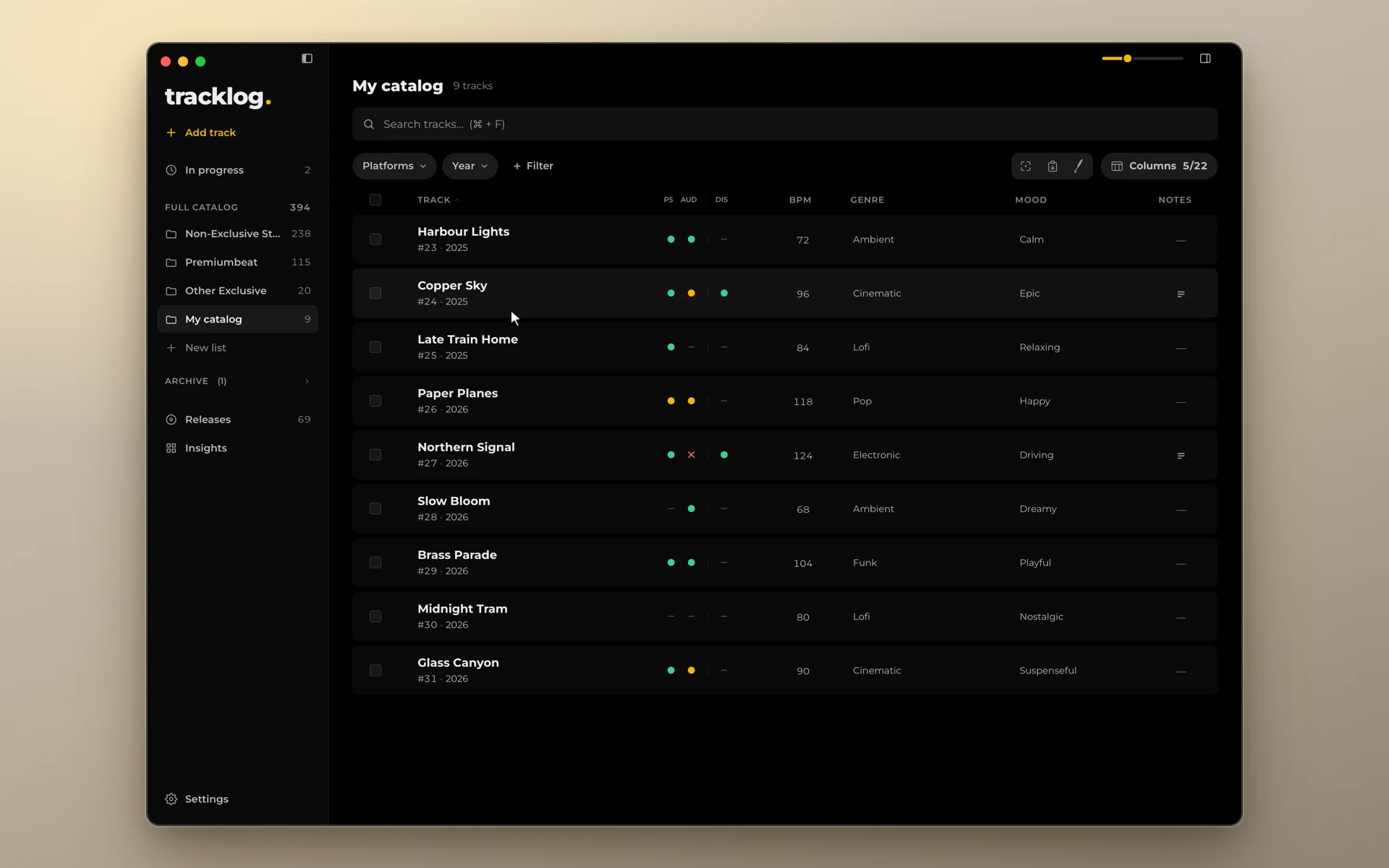
That last step needs a record. One row for each track, one column for each place. Treat your PRO and Content ID as columns too. See How to keep track of where your music is uploaded.
Sources
- What is Social Media Pack?, DistroKid Help
- FUGA expands global UGC and rights management offering with integration of AdRev, FUGA
- How Much of My Earnings Does DistroKid Keep?, DistroKid Help
- Ownership of Your Music, DistroKid Help
- What is YouTube Content ID?, DistroKid Help
- Eligibility for YouTube Content ID Through The Social Media Pack Extra, DistroKid Help
- What content is eligible for Social Video Monetization?, CD Baby Help
- Content eligible for Content ID, YouTube Help
- Motion Array upload rules, Motion Array Artists Hub
- Music, Pond5 Contributor Portal
- Registering Your Music With YouTube Content ID, Envato Author Help Center
- Claim Clear: Automatically Clear YouTube Content ID Claims, Envato Author Help Center
- Changes to Envato Market revenue share and exclusivity, Envato Author Hub
- Frequently asked questions for artists, Epidemic Sound
- Artist registration, Audiosocket
- About ASCAP, ASCAP